Do you have what it takes to be British?

Last year, I happened to be in a registry office in London, and overheard people who had just taken the British citizenship test talking about the difference between public holidays and bank holidays (do you know the difference?). Recently I saw this book, and thought I’d give it a quick read.

Teach Yourself British Citizenship Test

In 2005, the British government decided that everyone who is naturalised or given indefinite leave to remain in the UK, should be expected to pass a test about “Life in the UK” as a prerequisite. I was interested to know what kind of knowledge was regarded as so necessary to being a British citizen.

I expected it to be completely idiotic, so in some ways, I was pleasantly surprised. Lots of the information you’re expected to read and learn for the test is about peoples rights, and services and charities that can help you. Some of it is information that you really should be told about the way the UK works for your own benefit. This is good stuff, and I’m in favour of making sure that people who live here know these things.

Which of these two statements is correct?

  1. You can contact your MP by letter or phone at their constituency office or at the House of Commons.
  2. If you want to contact your MP you must go to the House of Commons.

Which of these two statements is correct?

  1. The general public are not allowed inside Parliament.
  2. The general public can visit Parliament by getting tickets from their MP or by queuing at the public entrance.

Citizens of EU member states have the right to travel to or work in other EU countries.

  1. True
  2. False

Which of these statements is correct?

  1. The Citizens Advice Bureau will advise you on housing problems
  2. You must consult the local authority about housing problems

And so on, making sure that you know Shelter is a housing charity, how to look for work, that you can’t believe everything you read in newspapers, that you know that you can vote, that you know you can’t be chucked out of your house by the landlord, how to use the NHS, that you know your kids have to go to school, and that you know what documentation you’ll need to get a bank account or register with a doctor. All information really that anyone moving to the UK should be given.

There are questions in between, things about customs, what most Britons eat for Christmas dinner, how most folk bring up their kids, general history about the ethnic roots of the people who live in the UK and the common religions, stuff that isn’t tremendously important, but might be useful for people to know. Then there are the other sorts of questions. General knowledge facts that most Britons would be entirely unaware of, that help you not a bit and that somehow are thought to be so important for foreigners moving to the UK to know that they’re included in the test.

How many members of the Scottish Parliament are there?

  1. 129
  2. 130
  3. 219
  4. 229

When was the present voting age set?

  1. 1918
  2. 1928
  3. 1969
  4. 1971

When was the Council of Europe created?

  1. 1973
  2. 1957
  3. 1949
  4. 2004

In what year did the Gunpowder Plot take place?

  1. 1705
  2. 1805
  3. 1516
  4. 1605

How many seats are there in the European Parliament for representatives from the UK

  1. 250
  2. 98
  3. 78
  4. 28

And there are a few further requirements. There are the numerous forms that must be filled in for a start. You have to pay 655 pounds, swear a bizzare oath of allegiance to the Queen (something many born Britons would never do), and attend a Welcoming ceremony where you will have to sit through speeches by “local dignitaries”. If you do not attend the welcoming ceremony within 90 days, not only do you not become a citizen, but you have to make a new application, pay the fee again (since the cost of the welcoming ceremony is included in the fee) and attend another. I’m not a big fan of ceremonies personally, I didn’t attend my graduation, however I’m not totally against the idea of a welcoming ceremony. The whole point of the welcoming ceremony is to try to make an occasion of it. However for it to be truly welcoming, perhaps it should be paid for by the UK, be noncompulsory, and interesting enough to make people actually want to attend. Maybe a concert from British bands keen to welcome the new citizens. Perhaps a couple of comedians, and yes, maybe then a speech from a “local dignitary”, but I think citizenship welcoming ceremonies should move with the times. It should be something that people are jealous you are going to and it should include real British people who aren’t doing it just because they’re paid to welcoming you.

Since before you can apply for naturalisation, and take the test, you must already have been living in the UK for at least 5 years, it does make some of the questions e.g. about what you need to open a bank account possibly a little out of date for you.

I’m not sure that I have the sheer determination, spare cash, patience, drive, form filling ability, and moral deviousness (swearing an oath I don’t agree with), to be British.

links for 2008-01-02

Happy New Year

I hope you had a good new year celebration, and that you’re looking forward to new challenges.

It’s become a bit of a tradition for us now to take a long walk for the new year, talking month by month through what happened in our lives, friendships and work, and about what things we’d like to achieve over the next year. We had a busy one this year.

We also like to light a fire. This year, since we live in a large urban area, the only bit of land we were sure we’d get away with it on was our car parking space.

warmcar parking fire

People walked past talking on their mobiles as we admired the shafts of light the street lights made cutting through the smoke (sadly didn’t get a picture of that – it was very cool). We’d run out of marshmallows unfortunately, and it’s hard to buy marshmallows at that time of night. Of course, we had to be careful putting the fire out.

puttingout.jpg

Ways people have found the site

Sometimes the things others say about you is more important than what you say about yourself. This is particularly true of search engines (and why I understand the importance of things like the wikia search initiative). Here are things that people have typed into google, yahoo, technorati, etc in 2007 and somehow ended up here:

  • economic advantages from Al Capone
  • cursed jewellery inheriting
  • photos of animals wearing eyeshields
  • rhymin method of birth control
  • what factors do you need to be aware of when designing the shape of your car to address speed and distance traveled?
  • Economic Opinions on Cereal Choices?
  • hard cor sex
  • I’m very sorry for what i write

links for 2007-12-12

Intimacy vs Outimacy

I’ve been taking part in discussing ‘ambient intimacy’ over on the disambiguity blog.

Personally, I think the phrase is oxymoronic. It doesn’t matter what secrets you shout from the roof, or who is listening, the fact that you’re shouting from the rooftop means that you’re not part of an intimate exchange. The value of what you say doesn’t lie simply in the information you transfer, but also in the wider context. If you only tell one person your real name, that can be enormously intimate. If you tell everyone, it means little. Intimacy is about showing and building trust beyond normal levels. For intimate exchanges, the level of privilege of the information can often be at least as important as the information itself.

I believe that for every relationship there is an appropriate level of intimacy, and more than is appropriate can be damaging, just as it is damaging to the relationship for there to be less intimacy than is appropriate.

Anyway, here’re my comments, from that page, complete with response.

Comment 102, written by: kyb

It’s not intimacy though. Intimacy can never be broadcast by its nature. Intimacy is about more than the knowing of details. It requires two way, privileged communication.

It may be that things like twitter encourage intimacy because it’s easier to enter into intimate exchanges with those you keep up with, but we shouldn’t mistake the two.

Comment 103, written by leisa.reichelt

hey kyb,

I can kind of see where you’re coming from here but I see things a little differently. For me, Twitter – for example – is not really ‘broadcast’ – even though my Tweets are public, I don’t think of them as going out to a vast and faceless audience, rather I think of the collection of individuals with whom I regularly share communications using this medium and am communicating to them, usually as a group, occasionally as individuals.

Secondly, I think of ambient intimacy as just one type of intimacy. It’s certainly not a substitute for all the other types of more direct and in-person intimacy (at least, it is not for me and I would hope not for anyone else). I do know that certainly my experience and the experience of many others that I’ve spoken to is that tools like Twitter and Flickr and Facebook and many others *do* create a experience of intimacy where, without these tools, there would almost certainly be none.

It doesn’t seem to be a universal experience, but certainly significant enough to be acknowledged.

Comment 104, written by kyb

leisa:

Thanks for the reply. As I understand intimacy, its very nature requires priviledged communication. If you talk about ‘intimate surroundings’ you’re talking about surroundings that encourage priviledged communication. If you say ‘getting intimate’, you mean that the people you’re talking about are priviledging each other in their communication. An ‘intimate group’ is a small group of people with a special bond. It’s this specialness that is important in the concept of intimacy.

Another important part of intimacy is not just that priviledged information is received, but that the reaction to its reception is part of the experience of intimacy. You can’t have an intimate conversation with someone who is watching the tv at the same time. A single email cannot convey intimacy although an email exchange can. Intimacy is two way, and most naturally (although not exclusively) synchronous.

Any broadcast that can be received by others (no matter who it’s intended audience) is by my definition not intimate. If someone who doesn’t know you at all can take part in the priviledged communication channel, then it’s not priviledged anymore, and therefore the transmission and reception of the information means less. I think that the extent to which it feels intimate is actually an illusion of false intimacy, and in some cases may even be harmful to the relationship.

I don’t want to suggest that there is therefore no value in things like twitter, im and all the other paraphenalia of social networking. It can obviously have enormous benefit, but it is almost direct opposition to the way I understand intimacy.

I’d even go so far as to call it outimacy.

links for 2007-12-07

Atoms of English

There’s an idea that just as English is composed of words, thought is composed of essential parts too. Perhaps there is a direct relationship between the most essential words and the most essential thoughts. How could we find out what are the atoms of thought, and what are just the molecules though?

Here’s one (quite unscientific) method. Take a dictionary, throw away all the words that don’t feature in any definitions since they can be described by other words, but aren’t needed to describe any word. Now, rewrite the definitions so that each word is replaced with its definition. Again, throw away any word that doesn’t feature in the new definitions. Continue boiling until you aren’t getting rid of words anymore.

I took Websters dictionary from the project Gutenberg site. I started with 95712 words. After the initial throwing away of words that weren’t in any definitions, I was down to 4489 words. After expanding them, and throwing away words that weren’t in the expanded definitions, I was down to 3601 words. Setting recursive definitions as atoms and continuing got me down to 2565 words, which should be enough to describe every thought you might have…

It turns out that a, b, c, d, e, f, g, h, i, j, k, l, n, o, q, s, t, u, v, w, y, z are the essential letters, leaving m, p, r and x as compound concepts.

I’m not sure how to reduce the number of words further, so here they are:

much, muck, vane, vamp, murk, mule, mull, vain, helve, mump, gland, tilth, musk, must, muss, mute, vase, soothe, souled, vast, glass, glare, scrimp, wrench, cove, cowl, pronged, hence, scurf, lance, scull, smouch, ketch, fy, glaze, ha, go, do, by, twinge, be, frock, itch, boast, cram, lynch, at, as, crab, an, tinge, no, of, realm, on, or, tined, board, pi, crew, me, my, ky, la, is, it, crib, in, slack, frond, front, up, to, frost, crow, crop, froth, so, reach, course, crup, frown, george, sleaved, gleet, club, clot, clog, lipped, inch, screw, scrim, scrip, fetch, screen, screed, billed, wythe, swathe, scrub, frill, clip, kibed, clew, clay, clan, clam, clap, claw, cock, code, large, coal, coat, pledge, quid, quit, quiz, frith, yacht, cope, cool, cook, coop, coot, cone, come, comb, waltz, cost, scribe, cork, corn, core, cord, scrap, colt, cold, coke, coin, tinned, coil, coif, taint, waffle, marked, glint, vive, reign, chit, chum, yeast, chop, corps, view, vice, yield, glide, terse, vine, gliff, char, chap, chat, scythe, fruit, nail, name, couch, spight, slish, waive, drain, waist, draft, slime, sling, slink, hoard, skilled, fierce, slide, plump, rinse, plumb, slice, pluck, drake, drape, right, scroll, slake, vest, slang, slant, vert, keeve, vent, vend, slate, slave, veil, vein, veer, taste, slight, cough, court, count, kedge, juice, warmth, wreath, hitch, glove, gloss, sleek, sleep, gloom, wright, sleid, cell, reeve, ceil, shelve, weight, globe, cent, cede, scaled, tared, slope, sloop, meet, dawk, daze, meek, crouch, brown, broth, rock, robe, scent, mend, scene, roan, roam, roar, melt, brose, mess, mesh, mere, broom, brook, brood, mete, clinch, strength, ridge, wraith, douche, crotch, fault, loose, draught, meat, mean, meal, seethe, vole, void, tierce, bilge, iced, vote, paint, ghost, deed, deep, cracked, deck, dear, deal, dean, dead, deaf, priest, haunch, desk, dent, nappe, made, farce, make, mail, main, scant, midst, beast, mace, scale, scald, scalp, beard, mawk, math, mate, scarp, scarf, scare, scaup, manx, male, malt, mall, mask, beach, mash, mass, mast, tenth, marl, mark, mart, mars, tense, rive, knife, ring, rind, ripe, risk, rise, brunt, rift, squab, oared, conch, brush, ride, brute, rich, squib, squid, nerved, phono, shive, dace, copse, bight, dauk, date, dash, dart, dark, snatch, shift, shine, damp, dame, shirk, shire, shirt, daft, basque, scrape, knell, scrawl, shawl, shave, tease, laugh, sprain, birth, teach, scowl, coarse, scorn, score, scots, scour, birch, scout, scope, scoop, read, coach, rear, reap, rhyme, reed, reef, reek, reel, scold, latch, rein, false, kneed, rent, rest, knead, coast, lurch, bitts, stretch, mood, wretch, mole, sheer, sheet, moll, mohr, move, mown, shears, moss, most, mote, moth, more, scream, sheal, moon, moot, sheaf, shear, prince, praise, shell, shelf, mode, mock, moan, moat, fresh, louse, sherd, rave, watch, rant, rank, hoarse, rapt, rape, faith, rare, rate, rash, spread, rasp, faint, mite, teens, steeve, mill, milk, mild, milt, teeth, mink, mine, mind, minx, mire, miss, mist, search, rhumb, bouffe, curl, curb, cure, calced, curt, cusp, cusk, rage, raft, rake, raid, knight, rail, rain, waste, mince, preach, cube, rack, race, nerve, waved, hunk, hunt, lunge, hulk, hull, slush, huff, huge, beached, hued, looped, husk, hurt, hurl, shade, frank, shaft, trench, frame, shake, shall, frail, shame, launch, launce, shank, shape, share, sharp, shark, brave, brawl, braze, brass, weave, frieze, nautch, throat, press, pshaw, bathe, batch, wait, wail, stanch, wage, boat, wale, walk, wall, barge, wake, preen, throng, throne, wade, bridge, grunt, braid, brain, brail, born, bore, boss, bote, bout, brace, bowl, boil, ward, ware, want, brant, brand, based, bolt, bold, boll, hooked, bomb, wave, hatch, friend, warn, warm, wart, warp, bond, bone, wash, brake, boot, book, boom, boon, bright, nosed, night, norse, haunt, weed, wedge, weep, weak, weal, wear, just, jump, smack, north, junk, sail, sage, safe, notch, sack, small, click, blur, blue, smart, witch, cloak, ninth, blot, quench, blow, hawse, flange, breed, sylph, close, bream, break, bread, prill, prime, clock, print, pride, price, prick, breve, tryst, clout, clove, clown, cloth, cloud, bite, bird, bing, bile, bill, bilk, bind, bitt, winged, drunk, hound, house, hours, suite, berth, flanged, nude, numb, breathe, bide, joke, join, barbed, splint, odds, guards, dredge, death, perch, shrike, shrill, shrimp, ruck, fringe, winch, wince, cheese, shriek, shuck, scheme, shunt, bribe, brick, rust, bride, rush, brief, brine, bring, brink, wine, wind, rude, wing, wink, shrine, shrink, sphere, ruff, wipe, wise, wisp, wire, rule, with, twill, twine, welsh, smile, twist, dunce, halve, best, bend, bell, belt, bent, twice, beef, pitch, bear, beat, thrist, bead, beak, beam, thrive, thrill, stepped, thrips, bench, smith, smite, whelked, dulse, sulks, roll, knock, roil, root, height, rope, roof, room, prawn, rote, ross, rose, broad, rout, prank, knosp, thrall, shield, knout, pounce, well, welt, wend, bruise, webbed, west, sphinx, clump, barn, bark, bare, bard, wide, surge, bath, bate, bass, base, ditch, bane, band, bank, bang, balm, wild, shoot, will, shook, jibe, shore, short, shote, smear, shove, wife, shout, back, tweak, bait, bail, bake, ball, balk, bale, bald, stored, priced, jilt, thread, what, whig, whim, whip, whir, toast, weird, when, shroud, whet, whey, harsh, weigh, shoal, smell, smelt, shock, twang, cage, zone, spar, writ, span, flute, flush, brusque, cheve, chest, fluke, wield, cave, drink, cheat, sour, soul, sort, sore, pinch, soph, soot, carl, carp, care, card, cart, cast, cash, case, cask, breach, drill, soon, cane, jest, camp, drive, sole, sold, cant, some, juggs, jerk, cake, cheep, cheer, cheek, soil, calm, call, calk, calf, check, soft, soak, soap, quitch, fleet, fleer, nine, taunt, snug, stuff, girth, snow, stunt, stump, hutch, flesh, stupe, voice, spoil, singe, spout, spoon, since, sinch, spoor, spool, sport, spore, strew, nice, nide, nick, nigh, strap, straw, stray, piled, strop, badge, strip, hurst, jeer, breath, breast, strum, strut, dried, glance, drift, spot, trine, spur, trill, school, spit, spin, trite, trice, trick, tride, tribe, breech, tried, schist, dress, clothe, chirk, spunk, chine, chink, troupe, child, chill, spurn, spurt, skid, quince, skip, skin, skim, chief, dream, trough, need, smoke, near, neat, neap, neck, style, smock, pique, spurred, wood, woof, flake, next, flail, newt, news, size, spleen, womb, nest, wolf, flash, flask, flare, judge, work, worm, flank, word, flame, float, smut, smug, flock, splent, snap, snag, hunch, flood, smee, smew, slow, slur, slug, dread, breeze, jack, jade, trend, floor, shrewd, sprig, slam, sled, width, flour, slim, flown, sprag, spray, slip, slit, cordate, tread, treat, slot, staves, truck, horse, writhe, branch, trump, trunk, sight, trust, truss, world, spice, noise, fleece, tooth, worth, worse, clang, clank, piece, chilled, clamp, pearl, peart, claim, probe, sphex, clare, clasp, class, sick, drove, side, pouched, sift, sign, deuce, prong, proof, butt, buzz, krems, clack, prose, proud, buoy, siss, prove, sire, bunk, bung, bump, site, bull, bulk, bulb, prowl, bush, burr, burn, buff, silk, silt, sink, toned, sine, sing, tongs, sham, zinc, shad, speck, speed, shed, childe, spell, spend, logged, shun, shut, legged, shin, ship, shop, show, shot, shoe, touch, tough, through, dense, note, nose, none, noon, scar, nonce, chase, charm, chart, chalk, chant, starch, scad, scab, whorled, furze, chair, chain, chafe, twitch, sand, salt, sake, chinch, flick, flirt, buck, trout, save, flint, fling, sash, split, droop, splay, grieve, keyed, clerk, smooth, noose, clear, cleat, clean, depth, seal, seam, cleft, sear, seat, gnash, seck, daunt, seed, seel, seek, troth, thrust, thrush, self, troll, send, brow, scow, flounce, spite, scum, starve, brun, ounce, nones, scye, spire, spike, spile, spill, spine, brag, prune, inched, vogue, bret, brew, brim, whiff, which, whirl, space, spade, whine, while, spalt, spasm, spare, spark, dance, zest, surd, sure, sunn, broach, suit, dough, salve, stern, such, doubt, suck, gneiss, crime, twelve, whisk, white, steak, steal, crisp, stub, bulge, stud, steam, sense, stop, stow, steep, steel, stir, there, stay, star, stab, stag, stew, stet, stem, step, poach, springe, thewed, douse, their, gift, ooze, gill, gild, knob, know, knot, knee, give, knit, bunch, spear, speak, gist, gird, girt, glib, glow, build, built, croak, crock, spright, glum, glue, sluice, glut, stark, start, stave, state, stake, stain, stall, stalk, stale, stamp, stand, flight, stack, stage, staff, serve, glad, blight, ache, eyed, goat, goal, goaf, goad, eyre, swim, swig, swop, croup, gnat, cross, crore, joule, crown, crowd, swab, sway, swan, joist, sized, speech, joint, thirst, stock, myrrh, glimpse, light, sauce, sault, else, crude, whole, crumb, grease, whoop, whore, crump, crust, crush, gaze, clause, gape, gang, gaul, gate, gash, gasp, crowned, garb, stork, store, gaff, storm, gage, stool, stoop, gain, gauze, stone, gall, gale, game, stove, stout, stoup, sarse, grace, grade, coursed, gauge, march, once, stink, sting, stint, still, stilt, stiff, stick, seize, marsh, polled, tail, tang, tamp, tame, tall, talk, take, tart, tare, garth, tape, task, south, sound, match, burst, geld, liege, burke, germ, sheathe, gear, tack, porte, wheeled, foxed, wicked, eight, dodge, fuse, moist, plague, stringed, funk, fund, twaite, full, thou, feud, they, fell, thin, this, fend, felt, quail, quake, fear, that, than, feed, feel, quart, choose, sconce, quash, tend, gripe, cowled, tent, tell, teil, grist, teem, pawl, pawn, grill, teat, tear, pave, quack, team, path, past, pass, parch, paste, vault, sponge, porch, lapsed, scratch, park, pare, faints, part, text, pale, palm, pall, pang, test, apse, page, pair, pain, paid, pack, rogue, term, scorch, fyke, thrack, young, crined, leaved, arched, arch, fish, graze, fist, firm, fire, grave, formed, fitz, five, roast, fizz, queue, graft, fife, fief, yoke, grail, grain, vexed, file, grasp, grass, tailed, querl, peaked, grate, quest, quell, grant, grand, finn, fine, find, fill, time, auld, queer, queen, tilt, till, tile, greed, crunch, tift, great, scotch, greek, green, veined, paned, kail, thus, tier, tide, tick, chord, chops, choke, peak, pear, forked, chock, flex, flea, solve, peck, flay, flaw, flax, flat, flap, flag, peel, peen, peer, perk, pelt, pest, toll, tomb, tone, groom, scouse, tool, tope, sparse, toed, groan, wharf, flow, sparge, whaup, flux, grout, tote, toss, flip, tour, tout, budge, town, gross, group, sexed, chyme, mouthed, clutch, ribbed, bit, foil, bin, big, bob, kern, bog, leech, forge, box, bow, boy, ban, bag, bad, baa, bay, bat, bar, foam, mesne, force, beg, bee, bed, bey, quick, bid, cat, can, cap, quilt, quill, wormed, bug, bud, but, buy, tongue, bye, quite, aim, air, blithe, aid, and, poise, all, quaint, abb, month, age, add, adz, progue, ace, act, choice, keen, keel, keep, fowl, four, foul, forth, are, arc, arm, ark, fork, form, art, ash, ask, ape, fore, apt, point, foot, fool, awe, font, food, awk, awl, ass, fond, fold, auk, whelm, patch, where, lithe, year, yean, mound, mount, horned, mouth, mouse, yelp, yell, quoth, quote, fret, free, fred, chuck, fray, frog, from, found, face, wheel, fade, fact, prompt, scrolled, tube, tuck, sober, crease, fail, fair, tuft, fake, saint, fall, churn, fame, tune, tump, groined, fawn, lived, fate, kiss, fast, fare, farm, kite, tree, trap, trot, troy, leave, least, forced, learn, leash, lease, trip, trim, true, leach, clumps, pounced, kink, king, kind, kill, kiln, jet, sleeve, guise, drop, jar, jam, jag, jaw, twin, twig, purge, job, joy, thought, jog, jig, pray, jib, drum, drug, wrest, prim, prig, ire, draw, haired, prod, drag, prop, dram, drab, purse, kid, kin, kit, black, pussy, key, sprout, league, guide, fight, turn, turf, jug, cranked, tush, tusk, tight, guild, boiled, length, goose, haw, rowed, hay, hew, her, hen, hem, hip, type, his, hit, sledge, doze, god, swipe, down, dorr, swish, gum, backed, switch, fifth, guy, gut, swing, swine, lorn, lord, lore, wreak, lope, doit, loop, loom, loon, look, wreck, lone, long, dock, ice, growth, roust, rouse, paunch, done, frogged, vague, puff, lout, love, inn, ink, loud, lost, loss, dome, ill, dole, lose, how, loan, pure, loam, loaf, hog, purl, hot, load, hop, hoe, field, hug, pull, pulp, round, hub, pump, yaws, yawn, loft, hum, should, rouge, rough, yarn, yard, push, lock, chance, few, fee, fib, guess, guest, change, fay, fat, luck, far, fan, fag, luce, eye, punch, eve, lodge, elf, elm, elk, ell, end, egg, eke, bleak, gin, gib, gig, swamp, get, swage, gem, dung, swath, gag, gas, gar, gap, dupe, squeeze, dusk, dust, sward, smeared, swart, swarm, bleed, lure, duff, fur, faced, duke, lute, dump, fra, dumb, lust, dull, fro, fry, fox, for, fog, foe, lump, duck, fly, fig, fin, fir, fit, fix, horn, hour, hood, hook, dab, hoop, dag, dam, day, hope, blaze, cup, cue, hold, home, hole, hone, cut, leafed, sweal, swear, blade, sweat, cod, cog, con, cot, sweep, sweet, cry, blank, bland, swell, blast, cit, blare, ebb, sterned, ear, eat, wrist, write, squint, eel, wring, squill, edh, dur, squirt, squire, dot, hock, spring, dog, hoar, dun, dup, due, dub, dry, dib, dew, den, dim, din, dip, die, dig, heel, guard, heck, pith, red, rep, dike, verge, heir, raw, ray, heft, dill, rap, rat, dine, ram, help, dint, rot, row, rob, hemp, rod, hell, helm, dirk, dire, dish, disk, disc, dirt, herd, rip, rig, rim, rib, rye, run, rum, rut, pick, rub, charge, sad, sag, pink, pine, ping, say, saw, pile, heat, heap, hear, heal, head, pipe, lynx, six, shy, sit, sip, sin, sew, set, sea, see, sou, sow, church, sol, son, sod, raised, fleeced, sky, limbed, sly, wrong, wroth, sty, sue, sum, sup, sun, blink, blind, tag, tax, taw, tau, tar, tap, tan, dice, snuff, pulse, par, pat, paw, pay, pad, pap, pan, chaste, loath, magged, mease, pew, plea, pen, per, pet, peg, ply, play, pie, pig, plan, pin, pip, pit, poy, pox, pop, pot, pry, curve, aisle, put, pun, pug, pyx, groove, harp, plot, hard, hall, hale, half, verse, hake, hang, hand, hawk, plum, plug, haze, hate, hash, hasp, have, haul, hive, eighth, net, sleave, new, nap, hind, hill, square, hire, grange, hint, gourd, nul, nun, high, nod, spruce, not, nor, now, gouge, chouse, nib, nip, chough, ohm, thyme, oil, poll, pole, strained, poke, odd, pound, grouse, pond, off, oak, own, mulch, owe, our, out, pouch, ground, ore, corked, orb, old, stitch, one, lag, lap, lar, law, lax, lay, lop, loo, log, lot, blotch, low, lug, pour, pout, port, prayer, pose, lex, post, let, leg, lee, nurse, pons, pool, lip, bowse, lin, poor, poop, lid, lie, mad, map, man, may, mat, mew, mob, mop, mow, mud, hewn, gorge, mix, mid, keeled, thump, thumb, stream, snood, snort, streak, skirt, bound, thatch, skill, skiff, jawed, edge, pierce, each, blown, blote, ease, east, bloom, earl, earn, fives, curled, blood, block, plate, trawl, yea, yen, yew, yet, trash, feast, tramp, plant, strain, plank, strait, plane, trail, train, trait, plash, strand, place, shirred, trade, plait, strath, plaid, plain, trace, track, tract, gyte, though, leet, leer, feign, hinge, lead, leaf, lean, leak, leap, blunt, strike, stride, strict, feint, blush, wry, thrid, wet, web, who, throw, wis, win, why, smudge, bluff, thrum, wan, wax, way, war, was, wag, wad, haft, hair, hail, hack, three, vow, vat, sniff, use, urn, snide, laze, stress, straight, brooch, lard, last, phrase, lash, tun, late, tub, tug, lave, two, try, lake, toe, land, lane, lank, toy, tow, ton, too, top, lamb, lame, lamp, tie, tin, tip, tic, tid, boots, ten, lade, tea, lace, lack, spired, the, bronze, gree, dyke, gray, boned, health, grit, grip, lick, lieu, life, lief, blanch, like, link, line, limp, lime, plight, lift, eared, wooled, cause, grub, swoop, gros, grow, sword, urge, sneer, crack, sneak, crane, crank, gold, thorn, crape, good, crass, gong, freight, crate, craft, gorm, gore, crake, gown, cramp, raise, left, lend, lere, craze, fanged, earth, less, stripe, chinned, string, lewd, strive, necked, range, plead, thick, snare, snarl, think, sleeved, heath, heart, third, heave, snail, snake, creak, cream, stroke, creep, carte, carve, strong, hearse, crest, creux, bogue, slough, plunge, first, gust, gush, browed, lint, gulf, live, list, lisp, catch, fence, hedge

Presence in Virtual Worlds

There have been a lot of experiments conducted to establish how much people feel “present” in virtual words. Loosely, this is usually defined as how much a person reacts to the virtual objects as if they were real (this paper (pdf) gives a good sense of it in its first paragraph). One of my friends in a 3d virtual environment recently wanted to sit on a chair. He’d been so taken in by the quality of the illusion that for a moment he treated the virtual chair as if it actually could support his weight. This is presence, and it’s the zenith of what we aspire to.

Actually, I don’t think it is. I don’t have a nebulous feeling of ‘presence’ in VR, but then I don’t when I’m in a shop, or at work, and sometimes I specifically feel unpresent in the real world. If I’ve been reading a good book, I feel that I’m more in its world than in this one. I think that almost all of these experiments suffer from a way of thinking that almost negates what the experimenters themselves are hoping for. They all start from the assumption that the virtual world is not real, and there’s a difference between it and the real world.

In fact, when I’m in a new environment, real or virtual, I treat it the same. I explore, I try to work out the rules of this new space. I experiment. If I find that the chair in this environment is insubstantial and I can pass my hand right through it, I don’t think that the chair somehow isn’t real, I simply realise that it’s a new kind of real chair, a chair I can’t sit on. I’d be the same in reality if someone gave me an insubstantial chair.

Nobody reacts in a 3d environment as if they are simply being shown patterns of projected colours, just like nobody treats the TV they’re watching Schindlers List on as if it’s just a mesh of colours, or for that matter – nobody treats a book as a bunch of squiggles on sheets. Art is a virtual reality that we explore, experience and decode. In neither simulators nor the walking around world do we experience unfiltered reality. What we experience are the concepts that our environment suggests to us.

There’s no question in my mind that Crayola land, where some of my other friends taunted crudely drawn ducks, or the library, where I was briefly menaced by a ghost child while books flew around are real places. They are just spaces with different rules to spaces I’m used to, and spaces where the assumptions I’m used to don’t always hold. We spend a lot of our lives, particularly when we’re young, working out what is real and what isn’t, and it’s exhilarating to be in that place of possibilities. Reality is a puzzle, and we love to try to solve it.

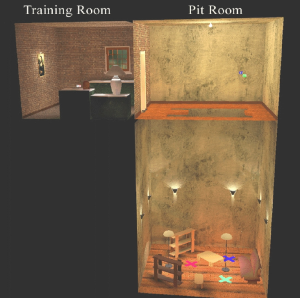
One of the presence experiments that has been carried out many times is the Pit experiment (pdf). People are asked to conduct a simple task in the virtual environment, and then relatively suddenly are confronted with a huge hole in the floor. Physiological measures show that their heart rate goes up, and their skin conductance changes. Is it Presence? Have people responded to the ‘virtual pit’ in the same way as they would to a ‘real pit’?

The Pit Experiment

I don’t think so, even though when I was there, I nearly lost my balance stepping out over it. (Did me talking about it as if it was really ‘there’ bother you?) I responded to it exactly as I would respond to a real pit – that I knew I couldn’t fall into, but that’s because it was a real pit that I knew I couldn’t fall into. There’s a difference between a ‘real pit’, which contains the notion of something you can fall into and a real pit that you can’t fall into. I’ve jumped out of an airplane, strapped into a parachute, knowing I was completely safe, but that doesn’t mean my heart rate didn’t go up. I responded to it not as I would respond to a real fall, but as I would respond to a real fall where I was safe – a virtual fall.

Of course, it’s difficult to run the experiments to prove this – you’d have to have an insubstantial chair to give me (and how would you carry it?), or run an experiment with a pit that people couldn’t fall into (perhaps using wires?) and compare it with a pit that they really could fall into. It’s difficult to get ethics approval for truly potentially life threatening experiments, even to try to establish a baseline.

And here we find some of the more interesting brand of presence experiments in virtual worlds. Doing experiments virtually that are too unethical to do in the real world. There’s the famous Milgram experiment for example, difficult to get approval for these days, but the virtual version is fine (I think it should be a compulsory part of education to watch the video of some of the 35% of people refusing to give the shocks in the original experiment. It’s inspiring). I saw an experiment where a virtual woman chatted up men, some of whom found her attractive and felt guilty with who knows what effects on the long term health of their relationships. The Millgram experiment is not ethically challenging because of its effect on the actor who is pretending to be shocked, it’s ethically challenging because of its effect on the participants. If people do respond in the same way to the virtual one as they do to the real one, then it’s just as unethical. There is nothing more or less real in the Virtual Milgram experiment than in the “real” one.

In some ways it’s more disturbing. Just like the man in a relationship who wondered if he was a freak because he found himself fancying a virtual woman, it is challenging to our sense of what it means to be human to discover our emotions and cherished empathy responses can be tricked and played so easily. And perhaps this is where the most interesting work is, searching the psyche for what makes us tick, because after all, finding out how we respond to what is inside our own and other peoples heads is even more important than finding out how we respond to various forms of the outside world.

I am VERY sorry for the delay

I’ve been upbraided by a number of people over the last few months for leaving this site to mature a little by itself recently.

The truth is that I’ve been gloriously busy. Fighting droids with lightsabers in virtual reality, implementing spectral clustering of three different kinds, k-means clustering, recursive ray tracing, going to a jyte meet-up, segmenting MRI scans of the brain, detecting edges, recognising characters, performing maximum flow network methods by hand, investigating the mathematical properties of artificial neurons, learning about more crazy mathematical concepts than you could shake a stick at, trying to balance on a slackline, preparing a web based streaming platform for its upcoming free community edition, thinking about new presentation techniques, playing with my convertible tablet pc, being given a sheep. Add to that the fact that I recently got married, and you can imagine that time is short. I’ve not even had time to browse the web much, so I’m getting flack from my delicious vampires who used to rely on me to find them interesting things to read.

Sorry guys.

It’ll probably not get much better either in the near future. It’s the age old problem, when you’ve time to write, it means you’re not doing interesting stuff to write about, when you’re doing interesting stuff there’s no time to write.

Anyway, I’ll post something tonight.